Menu
Menu
Why Enterprise AI Fails Without Business Context
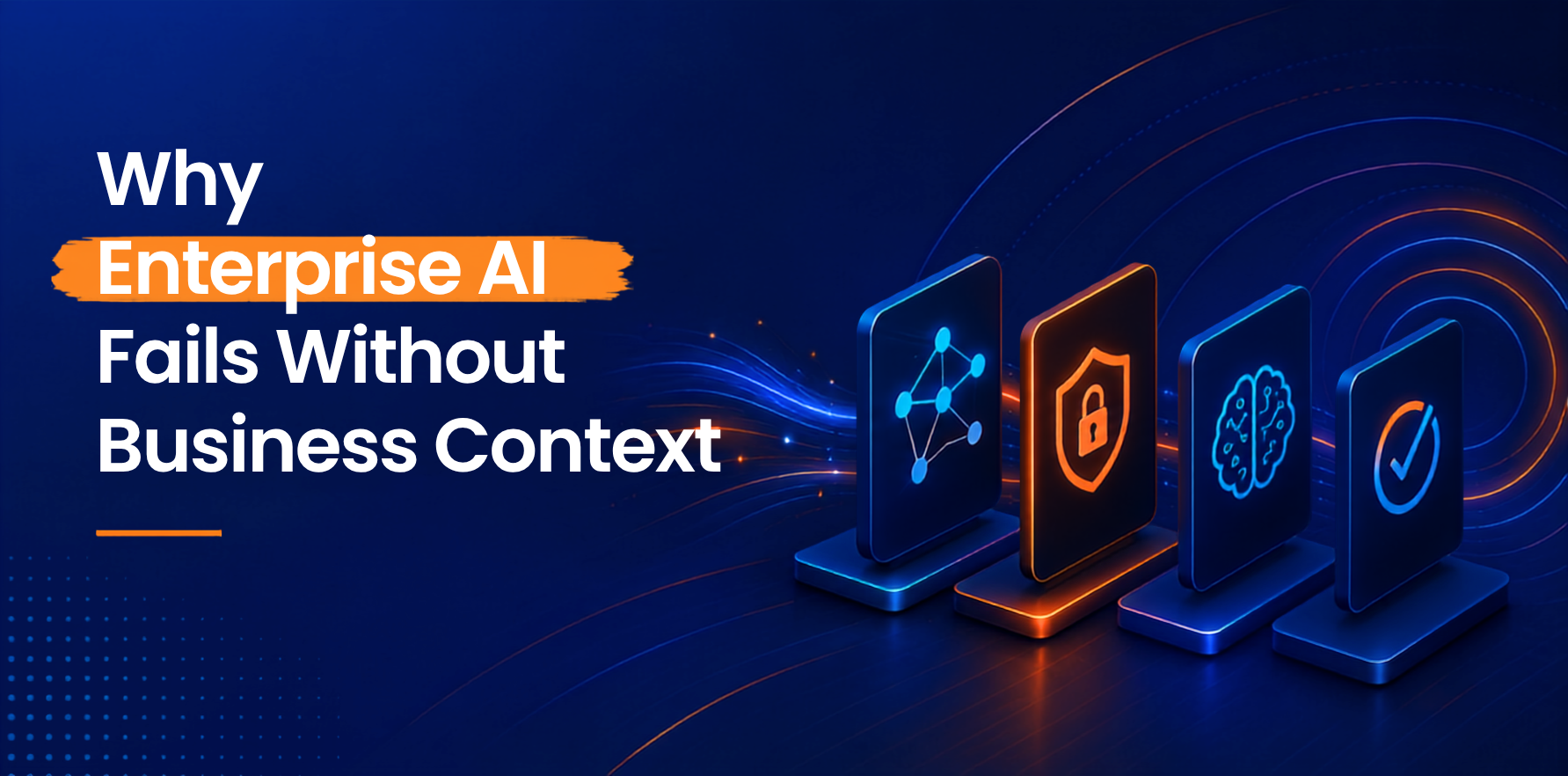
Enterprise AI has a data problem that has nothing to do with data quality. It has a meaning problem.
Getting an answer out of an AI system is easy. Getting the right business answer is hard — and that gap is exactly why most enterprise AI investment isn’t paying off yet.
Why This Is Urgent Now
A 2025 MIT NANDA study found that roughly 95% of enterprise generative AI pilots fail to produce measurable business impact — not because the models were weak, but because organizations weren’t structurally ready to use them. Gartner projects that by 2027, 60% of organizations will fail to realize the value they expected from AI simply because their governance is incohesive. The same MIT research found something worth sitting with: enterprises that paired internal teams with an experienced implementation partner succeeded two to three times more often than teams that built alone.
AI projects aren’t failing on model quality. They’re failing on business context.
The Real Failure Point
Ask an AI system, “What was our revenue last quarter?” It understands the words. What it doesn’t know — unless someone has told it — is which revenue definition your organization has actually approved. Does it include cancellations? Refunds? Is it booked, invoiced, or transacted?
Multiply that across every KPI. Customer Conversion Rate alone commonly has three valid definitions living inside the same company at once — booked customers over created leads, over qualified leads, or over same-month leads. All defensible. Only one is official. If that definition isn’t governed somewhere every AI tool can reach, different teams ask the same question and get different answers.
That’s not a hallucination problem. It’s an unmanaged business meaning problem, and no bigger model fixes it.
From Data to Trusted Intelligence — the Strategy One Approach
A semantic layer is the governed translation layer that turns raw tables into business vocabulary — Revenue, Active Customers, Churn — with the logic and security rules defined once and reused everywhere, instead of rebuilt inside every dashboard and prompt.
This is where Strategy One — the analytics and AI platform from Strategy, rebranded from MicroStrategy in 2025 — earns its place in this conversation. Its Semantic Graph lets an organization define revenue exactly once, and that single definition then flows untouched through Strategy One Library dashboards, Workstation self-service queries, Mobile analytics, Auto’s natural-language answers, and HyperIntelligence cards surfaced inside everyday apps. Nobody re-derives the number in a fourth place and gets a fourth answer. Strategy Mosaic, the platform’s Universal Semantic Layer, extends that same governed definition beyond Strategy One itself — into Snowflake, Fabric, Databricks, and other tools already in the stack — so governance doesn’t stop at one vendor’s edge.
But governed meaning is only half of “trusted.” The other half is freshness — a perfectly governed definition running on stale data is still an answer nobody should act on.
Proof From the Field
Real-Time Intelligence for a 500M+ Interaction Platform. An AI-driven experience platform spanning finance, healthcare, and government needed users to analyze data the moment it was generated, without waiting on traditional ETL cycles or disrupting existing Strategy workflows. NICE built a real-time ingestion layer using OpenSearch on Elastic Search APIs, streaming data through WebSocket subscriptions into high-performance indexes, with fetch frequency tuned to balance speed against system load. The result: users get live insight inside their existing Strategy reports, decision-making accelerated measurably, and the organization eliminated its dependency on batch ETL schedules entirely — all without touching the systems teams already relied on.
The same governed-context principle shows up across other engagements. A retail team asking Auto for underperforming SKUs gets a number that matches finance’s monthly business review exactly, because both are resolving the same governed hierarchy. A financial services team running natural-language portfolio queries through Auto only ever sees the clients their existing role already permits — the AI inherits Strategy One’s row-level security rather than inventing a new, harder-to-audit permission layer. A manufacturing field rep gets a HyperIntelligence card inside their inbox showing a prospect’s open pipeline and payment status, pulled live from the same model used in the quarterly review, without leaving their email.
Why NICE
NICE Software Solutions has worked as a Strategy (formerly MicroStrategy) implementation and enablement partner for well over a decade — long before “AI governance” became a boardroom phrase. That history is why our approach starts with the business-context layer, not the model. In practice, that means architecting the governed, real-time foundation AI needs across banking, retail, manufacturing, and pharma — whether through a full Semantic Graph and real-time delivery build on Strategy One, or by embedding our consultants directly alongside an existing team to get a stalled build moving again.
Turn Strategy One Into Your Single Source of
Trusted Intelligence
Governed Meaning. Real-Time Data. AI You Can Actually Rely On.
FAQ’s
What is a semantic layer in enterprise AI?
A governed translation layer between raw data and business language. It defines metrics, hierarchies, and security rules once, centrally, so every report, dashboard, and AI tool reuses the same definitions instead of recalculating them independently.
Why do most enterprise AI pilots fail?
MIT NANDA research found that roughly 95% of enterprise generative AI pilots fail to deliver measurable impact — most often because AI was connected directly to raw data without a governed layer of business meaning and security in between.
Does this mean replacing our existing BI tools?
Usually not. Strategy Mosaic is built to extend governed definitions across existing tools — including Snowflake, Fabric, and Databricks — rather than force a rip-and-replace. The goal is one governed definition reused everywhere, not one vendor everywhere.
What should we prioritize before buying more AI tools?
Whether your core business definitions are standardized and centrally governed, whether AI can respect your existing security model instead of creating a new one, and whether users can trace any AI-generated answer back to a metric they already trust.
Final Thought
The enterprises that win the next phase of AI won’t simply be the ones with the biggest models. They’ll be the ones that gave AI something far harder to copy: business context that was already governed, trusted, and reusable before the AI ever arrived.
That’s the real question worth asking before the next AI budget gets approved — not which model should we buy, but does our AI actually understand our business, or is it still guessing?
NICE Software Solutions is a Data & AI engineering and consulting firm serving enterprises across North America, the Middle East, and APAC.
About The Authors:
Pranali Gadlinge
Senior Consultant
Mahesh Itankar
Marketing Executive
Recent Blogs