Menu
Menu
The Agentic Workforce: Why 2026 Marks a Shift in Enterprise AI
For the past two years, most enterprises have measured AI progress by adoption: how many licenses were purchased, how many employees used a chatbot, and how many drafts were generated faster. That was always a temporary way to keep score. Boards are no longer asking how many people are using AI; they are asking what it has produced.
That shift matters because conversational AI, by itself, does not complete work. It can respond, summarise, and assist, but it cannot reliably execute end-to-end business tasks. The more meaningful shift is happening with autonomous, tool-using AI agents — systems that can read data, take actions, and complete workflows with minimal human intervention. That is not a feature upgrade. It is an operating model change.
Why this matters now
The scale of the market reflects this transition. Grand View Research estimates the global AI agents market at $10.9 billion in 2026, with a projected rise to $182.9 billion by 2033, at a CAGR of 49.6%. At the same time, readiness remains limited: Gartner’s April 2026 CIO and Technology Executive Survey found
that only 17% of organisations had deployed AI agents, while more than 60% expected to do so within two years. Separately, a 2025 Gartner study of organisations actively investing in agentic AI found that more than 40% of such projects launched today will be cancelled by the end of 2027 because of cost, unclear business value, or weak risk controls.
That gap tells us something important. The bottleneck is not capability. It is readiness — in data architecture, governance, and workforce design.
Where many AI programs fall short
A lot of organisations now describe themselves as AI-enabled because teams use large language models to summarise documents or draft emails. That may improve productivity, but it does not change the operating model. It simply makes the current model faster.
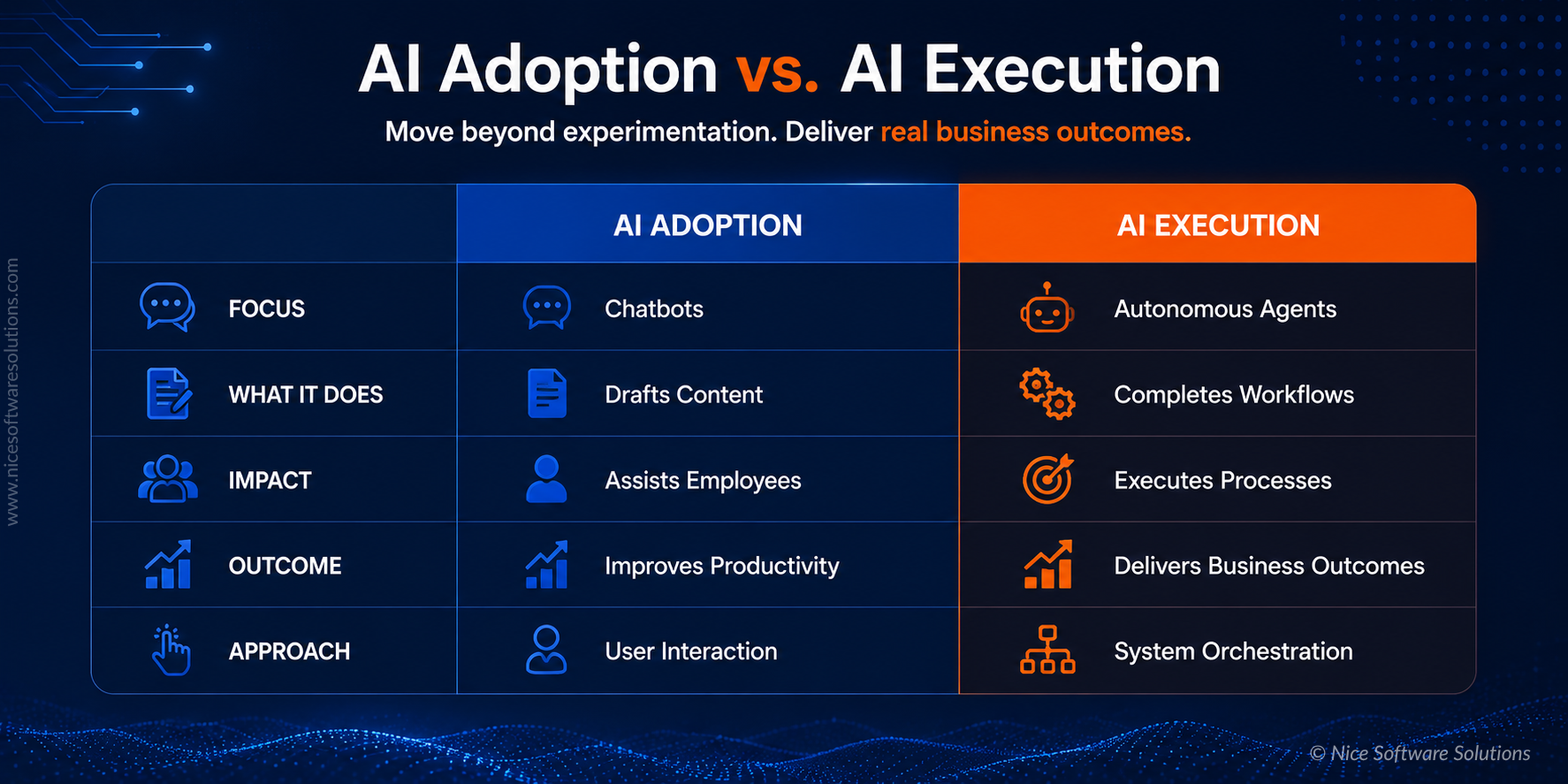
The real transformation happens when AI moves from being an interface to being an execution layer — one that can read from a data warehouse, write back to systems, and complete a task from start to finish without constant human handoff. That is where the business case becomes stronger, but also where the risks multiply. An agent is only as reliable as the data foundation beneath it, and if the data is messy or poorly governed, the automation will only scale bad decisions faster.
How we are approaching it at NSS
At Nice Software Solutions, we have taken a deliberate approach to building for this shift internally before scaling it externally. Rather than treating AI as a set of point tools, we are embedding agents into engineering and delivery workflows while also upskilling teams to work alongside them.
That approach is already reshaping how we think about execution. In QA, agents help predict regression risks and generate validation test suites. In data operations, they support query optimisation across cloud data platforms such as Snowflake and Databricks. The result is not just faster delivery; it is a better model for how human and machine capability should work together.
One example is QueryMate, our agent designed to help business users translate natural-language questions into optimised SQL and visual dashboards. It reduces dependency on the data team for routine queries and gives leaders faster access to decisions they need to make. That is the kind of practical value enterprise AI should be delivering.
Proof from the field
We have seen this pattern outside our own walls. A leading Continuing Education and Training provider, serving more than 34,000 organisations and 3.2 million learners, faced a familiar bottleneck: business teams depended on analysts for even basic reports, and IT absorbed the overflow. We built an agent that lets anyone ask a plain-language question and get back a dashboard or summary in seconds, built with the same rigour around access and security as any core business system.
The result was faster reporting, a lighter load on analysts and IT, and a self-service model that has since spread well beyond its original use case. The pattern matches what industry research shows more broadly: organisations that deploy natural language query interfaces typically cut analysis time for non-technical users by around 40% and shrink IT reporting backlogs by as much as 70%, turning report requests that once took days into a conversation that takes minutes.
We see the same pattern in banking. At a large regional bank, business analysts were blocked from self service insight by SQL dependency: every question about customer or account data needed a technical resource, and even routine queries took days to turn around.
We built an AI-powered assistant, in the same spirit as QueryMate, that lets relationship managers and analysts query that data directly in plain language. Turnaround on ad-hoc queries dropped from days to minutes, a roughly 90% reduction; analyst time spent on data retrieval fell by around 60%; and the volume of SQL tickets reaching the BI team dropped an estimated 40–50%.
Performance insight that once required a data team is now self-served across the entire relationship-management function. That is the test boards should apply to any ‘AI powered’ product: does it inform the decision, or does it also do the work?
Discover how QueryMate transforms productivity and
unlocks business value for Enterprises.
My Two Cents
The next phase of AI adoption will not be won by organisations that simply buy more tools. It will be won by those that redesign talent, data, and governance around execution.
1. Stop hiring only for syntax; hire for orchestration. The most valuable teams will be those that can design, govern, and debug agentic workflows.
2. Clean the data substrate before scaling agents. Without governed, reliable data layers, agents will not produce trustworthy outcomes.
3. Build governance from day one. Define ownership, permissions, and auditability before deployment, not after.
4. Upskill the workforce early. AI agents should remove routine friction so people can focus on higher value judgment, strategy, and client outcomes.
The broader shift
The agentic era is not a software upgrade rolling out quietly in the background. It is a redrawing of where human judgment sits in the enterprise, and which parts of the operating model no longer need a human in the loop at all. Every organisation is already running this experiment, whether its board has named it or not: somewhere inside the business, a workflow that used to require a person now runs on an agent that reads, decides, and acts on its own.
The organisations pulling ahead are not the ones with the most AI licenses. They are the ones with the discipline to rebuild the data, governance, and talent underneath the agent before they switched it on.
That is the real shift underway: from AI as assistance to AI as operational capacity. Boards that still treat this as an IT initiative will find themselves competing against boards that have already made it a structural one.
The question for every board this year isn’t whether they’ve adopted AI. It’s whether it’s actually doing the work.
NICE Software Solutions is a premier Data & AI engineering solutions provider across North America, Middle East, and South Asia.
About The Author:

Deep Saraf
CEO, Nice Software Solutions
Recent Blogs