
Menu
Menu
The Rise of Unified Data Platforms:
Why Fragmentation Is Your Biggest Hidden Cost
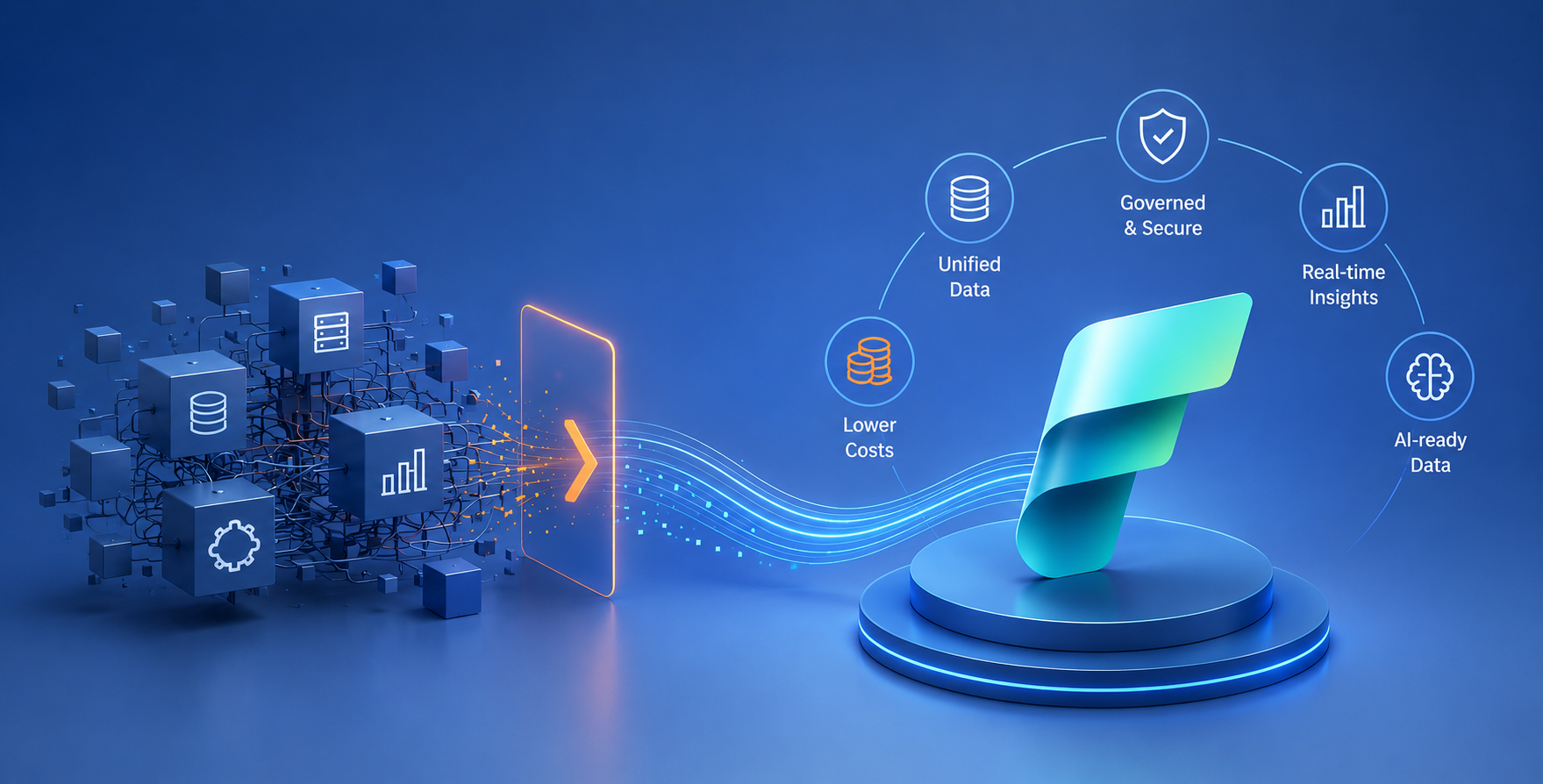
1. The Market Moment: Why This Matters Right Now
In 2024, two things happened simultaneously across enterprise boardrooms in the United States and the Middle East. AI mandates arrived — and data architectures cracked under the pressure.
In the US, the Inflation Reduction Act and a wave of federal digital transformation initiatives pushed regulated industries — healthcare, financial services, public sector — to modernise data infrastructure at pace. In the GCC, Saudi Arabia’s National Data Management Office (NDMO) and the UAE’s Personal Data Protection Law (PDPL) elevated data governance from a back-office concern to a board-level mandate. Vision 2030 in KSA set explicit targets for data-driven public services and private sector competitiveness.
At the same moment, generative AI projects stalled — not because of a lack of ambition, but because the data underneath was fractured, inconsistent, and ungoverned. Every AI project exposed the same underlying problem: fragmented data architecture.
The Defining Question of 2026 – 2027
Can your data infrastructure support the AI-driven decisions your business needs — at the speed the market demands?
For most enterprises operating on fragmented stacks, the honest answer is: not yet.
2. The Business Case — What Fragmentation Is Actually Costing You
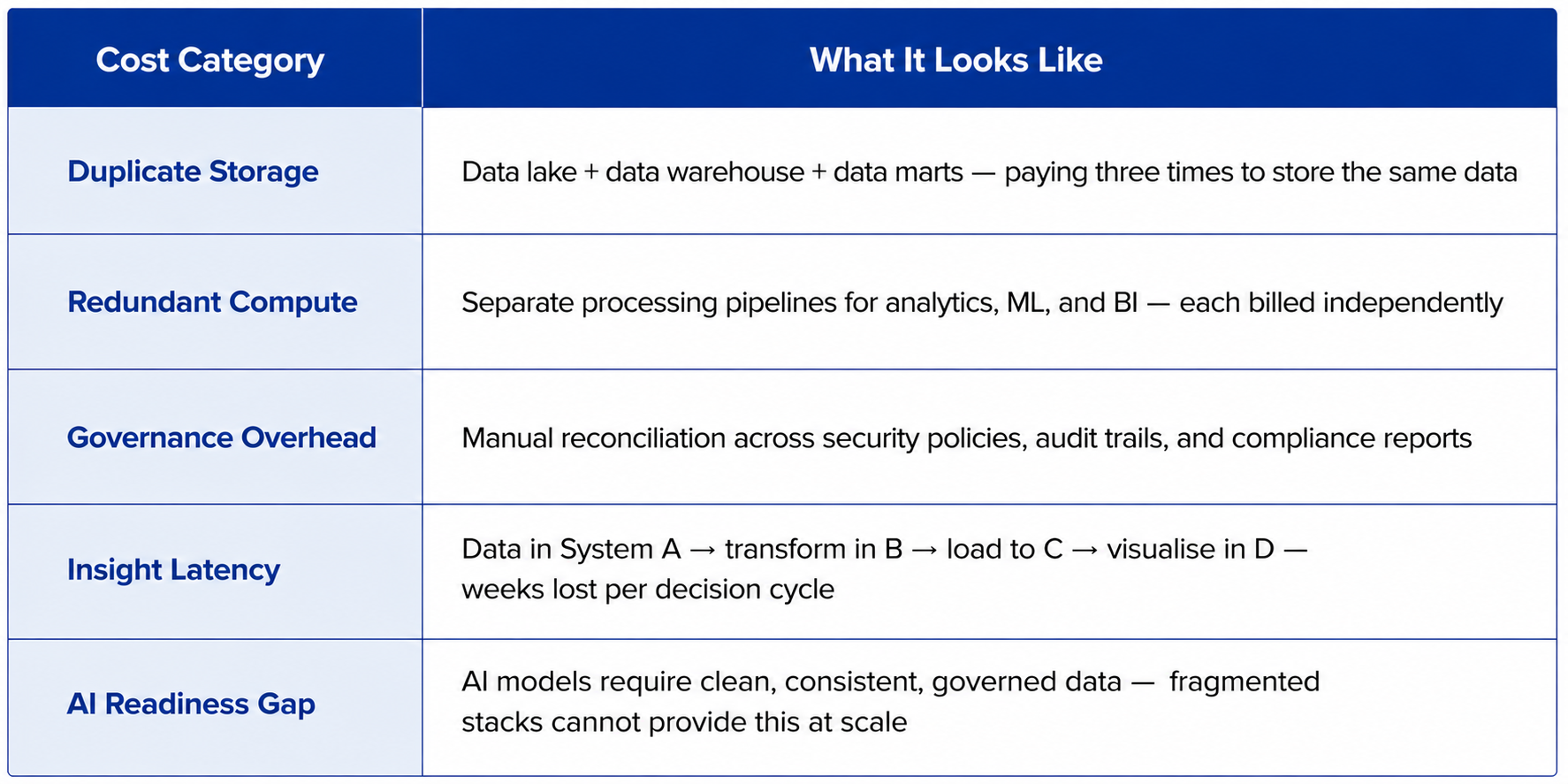
Before evaluating platforms, CXOs need to understand the true cost of the status quo. Fragmentation is rarely one large, visible line item. It hides across your infrastructure, your people, and your missed opportunities.
The Hidden Cost Anatomy
Industry Signal:
Gartner’s top trends for 2026 identify data and analytics platform convergence as a defining force — alongside AI agents and semantic intelligence — with more than 1 in 10 enterprises projected to be AI-first by 2030 through adoption of converged platforms (Gartner, 2026). Global data volumes have already surpassed 120 zettabytes and are projected to exceed 180 zettabytes by 2027 (IDC). Fragmented architectures are not built to scale at this pace.
The Self-Assessment: Is Fragmentation Costing You?
Answer honestly:
• Are your teams using three or more tools for a single analytical workflow?
• Does governance require manual effort across multiple systems?
• Are real-time insights a competitive advantage you currently lack?
• Is your AI initiative stalled waiting for clean, reliable data?
• Is your data infrastructure growing slower than your data volumes?
If you answered yes to two or more: fragmentation is actively costing you money, market position, and AI momentum.
3. The Strategic Shift — Why Unified Platforms Are Winning
The market isn’t debating whether to unify. It’s debating how fast.
Unified data platforms consolidate storage, compute, governance, and analytics into a single, coherent ecosystem. The architecture shift eliminates the handoff tax — the time, cost, and error introduced every time data moves between disconnected systems.
Three Forces Accelerating Adoption
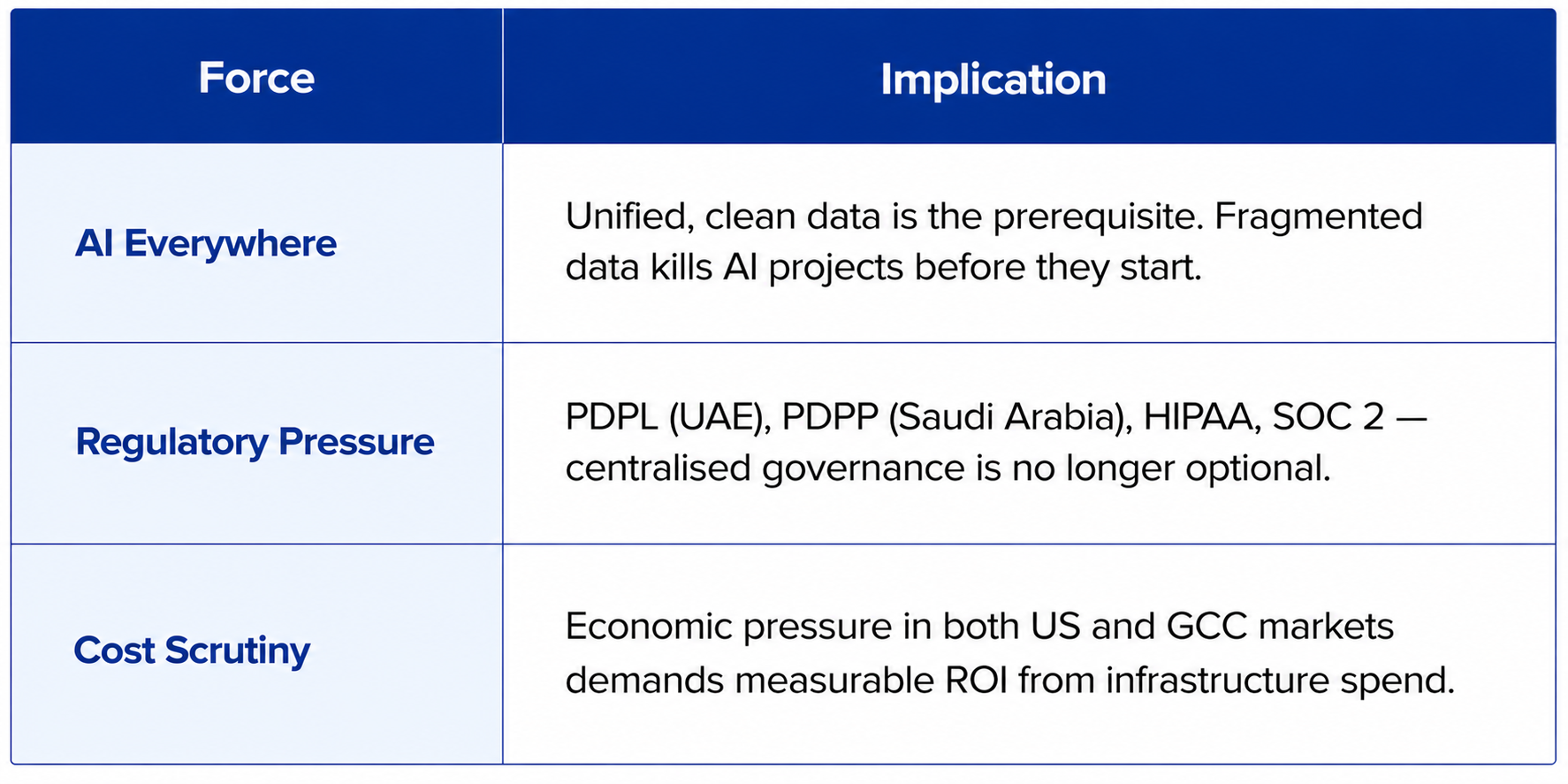
4. Microsoft Fabric — A Fundamental Reimagining of Enterprise Data
Microsoft Fabric is not an upgrade to an existing product. It is a ground-up reimagining of how enterprise data should work — built on a single architectural principle: one storage layer, one governance model, one source of truth.
The OneLake Foundation
Everything in Fabric is built on OneLake — a unified data lake that serves every workload across your organisation. One storage layer eliminates duplication. One governance layer eliminates compliance gaps. One view of data eliminates reconciliation.
Integrated Workloads — What’s Different from Traditional Tooling
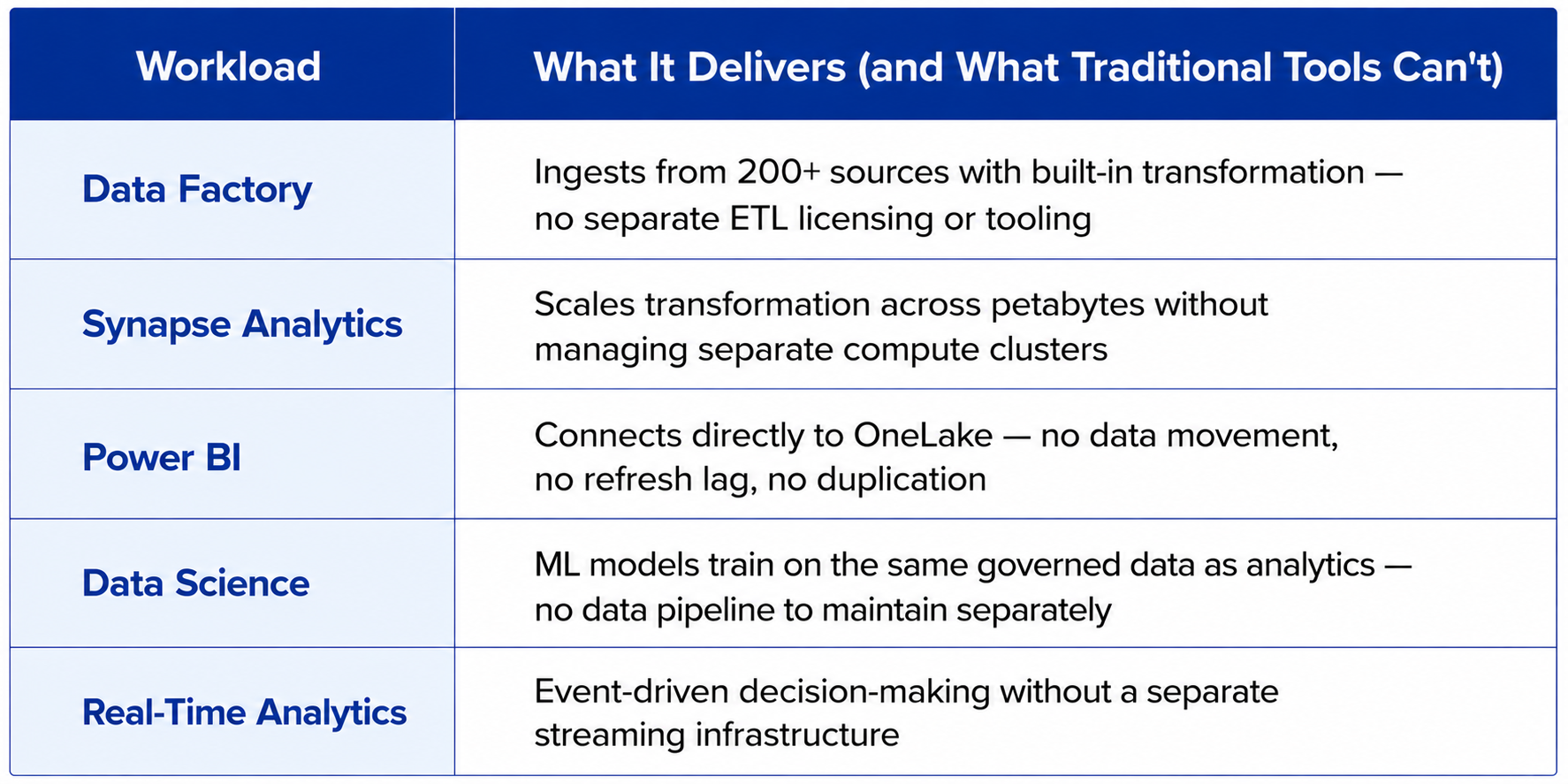
The Architectural Difference That Matters
Traditional enterprise stacks look like this:
Data Lake → ETL Pipeline → Data Warehouse → BI Tool → ML Platform → Governance Layer
Each arrow is a cost centre. Each integration is a failure point. Each system is a governance gap.
Fabric collapses this into:
OneLake → Unified Workloads (all native) → One Governance Layer → AI-Ready Output
This is not marginal optimisation. It is a structural change in how data flows through an organisation — and how fast decisions can be made from it.
Fabric and Compliance — Critical for US and Middle East Markets
For organisations operating under HIPAA, SOC 2, FedRAMP (US), PDPL (UAE), PDPP/NDMO (Saudi Arabia), or cross-border data residency requirements, Fabric’s centralised governance model directly addresses compliance complexity:
• Single audit trail across all workloads
• Data residency controls — specify where data is stored geographically
• Role-based access control managed from one pane, not scattered across tools
• Microsoft Purview integration for data lineage and classification
Modern Data Platforms Don’t Start with Technology.
They Start with Strategy.
Discover how leading enterprises are eliminating fragmentation, strengthening governance,
and building a unified foundation for AI
5. Real-World Impact — From Fragmented to Future-Ready
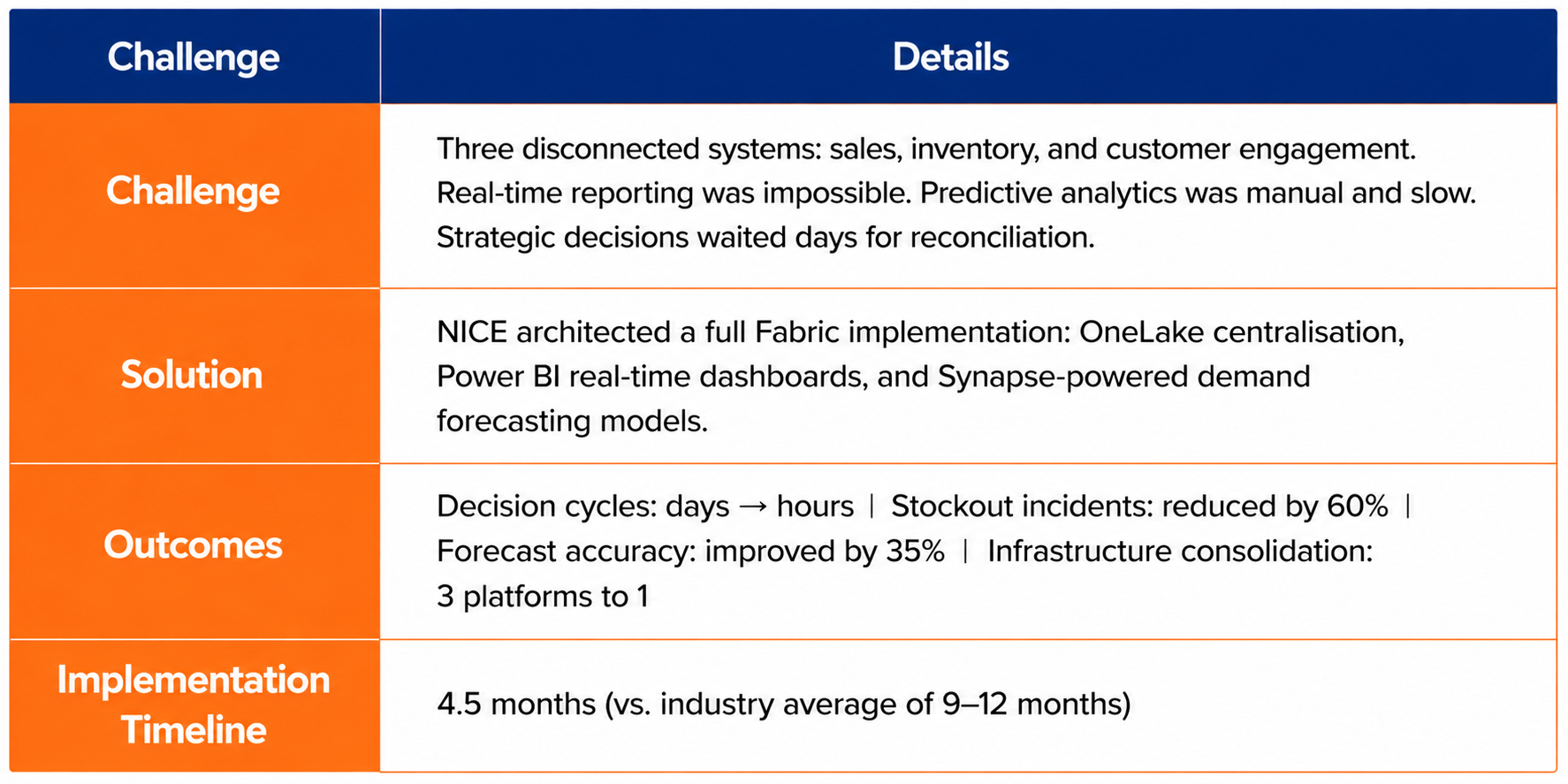
Case Study: Global Retail Organisation — Unified Commerce Intelligence
What NICE Has Observed Across Implementations
Across deployments in North America and the GCC region, NICE has consistently found three patterns that determine whether a Fabric implementation succeeds or stalls:
• The tool is only 30% of the equation. Organisations that buy Fabric and plug it into fragmented workflows see marginal gains. Strategy, architecture design, and change enablement drive the other 70% of value.
• Data quality must be addressed at ingestion, not retroactively. The leading cause of AI project failure in enterprise Fabric deployments is not the platform — it is pre-existing data quality issues that surface under unified governance.
• Adoption determines ROI. The most technically perfect Fabric deployment generates zero value if business users don’t trust or use the outputs. Change enablement is not optional.
6. Market Context — US and Middle East Considerations
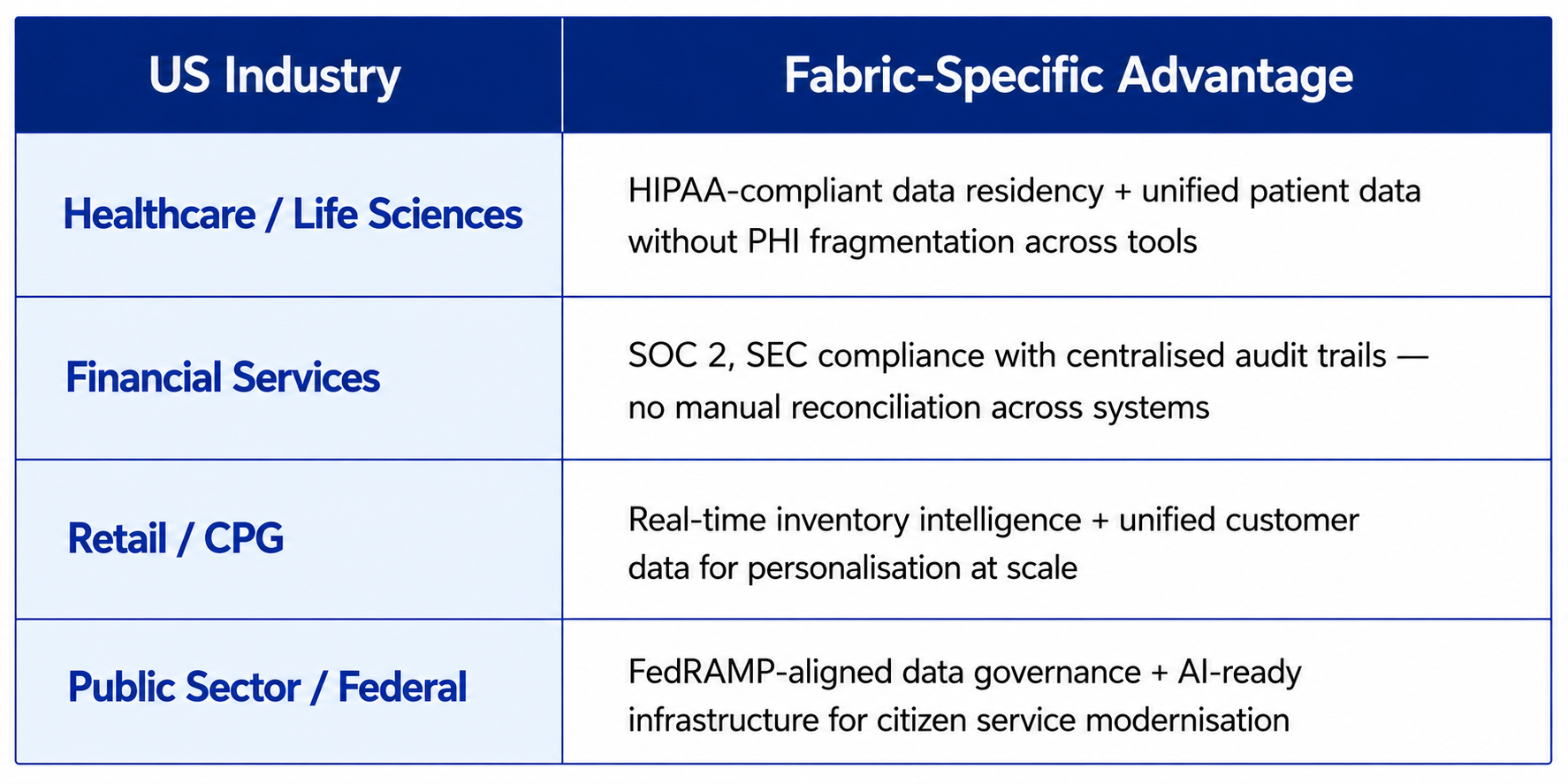
United States: The AI Compliance Intersection
US enterprises face a specific tension in 2026–2027: the pressure to deploy AI rapidly, against a backdrop of increasing data governance scrutiny in regulated industries. Unified platforms resolve this tension by making governance intrinsic rather than bolted on.
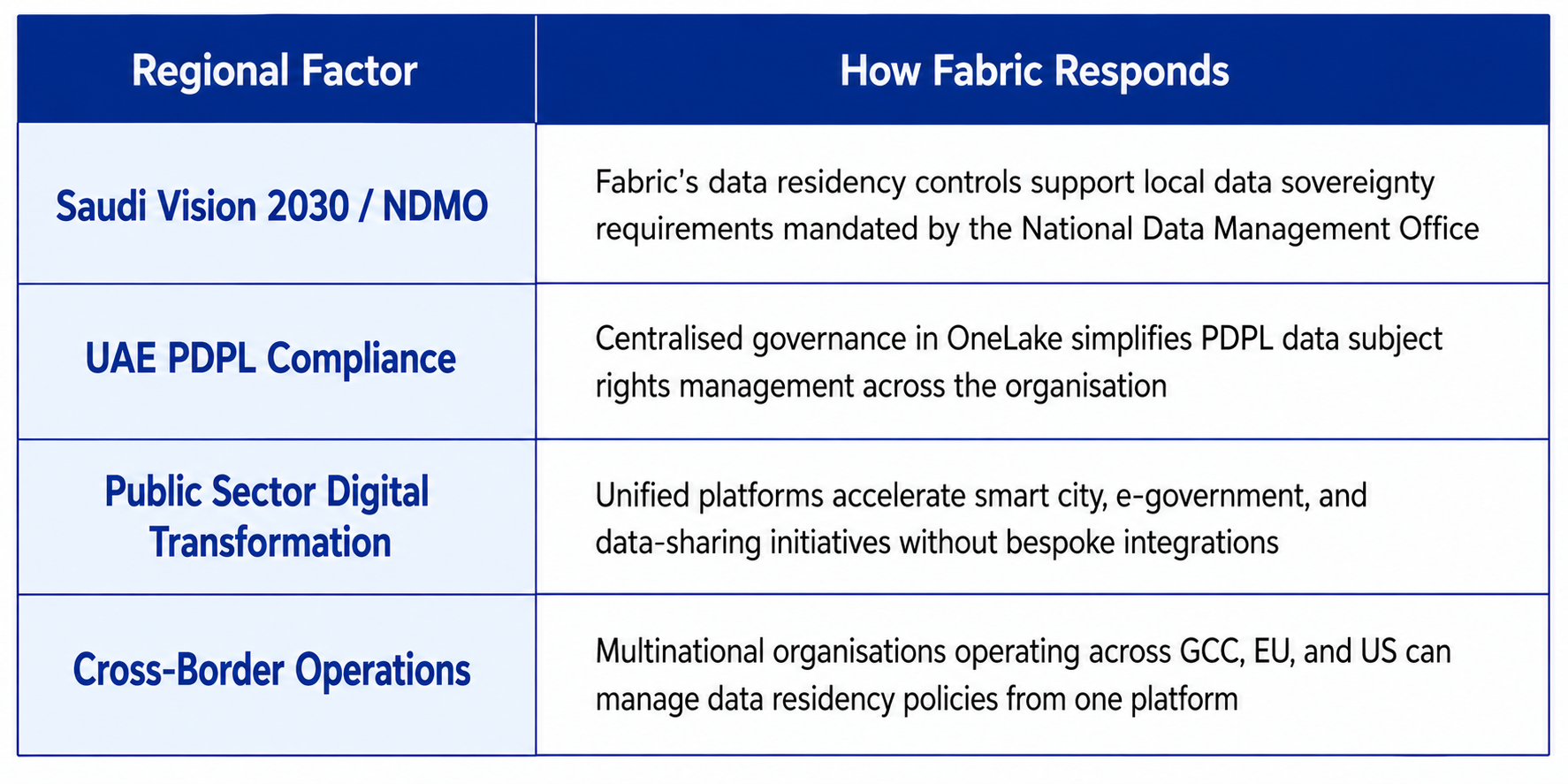
Middle East / GCC: Vision 2030 and Data Sovereignty
Across the GCC — particularly Saudi Arabia and the UAE — the data modernisation agenda is driven by national transformation targets, regulatory frameworks, and the ambition to become globally competitive data economies.
7. Why NICE — Strategy First, Technology Second
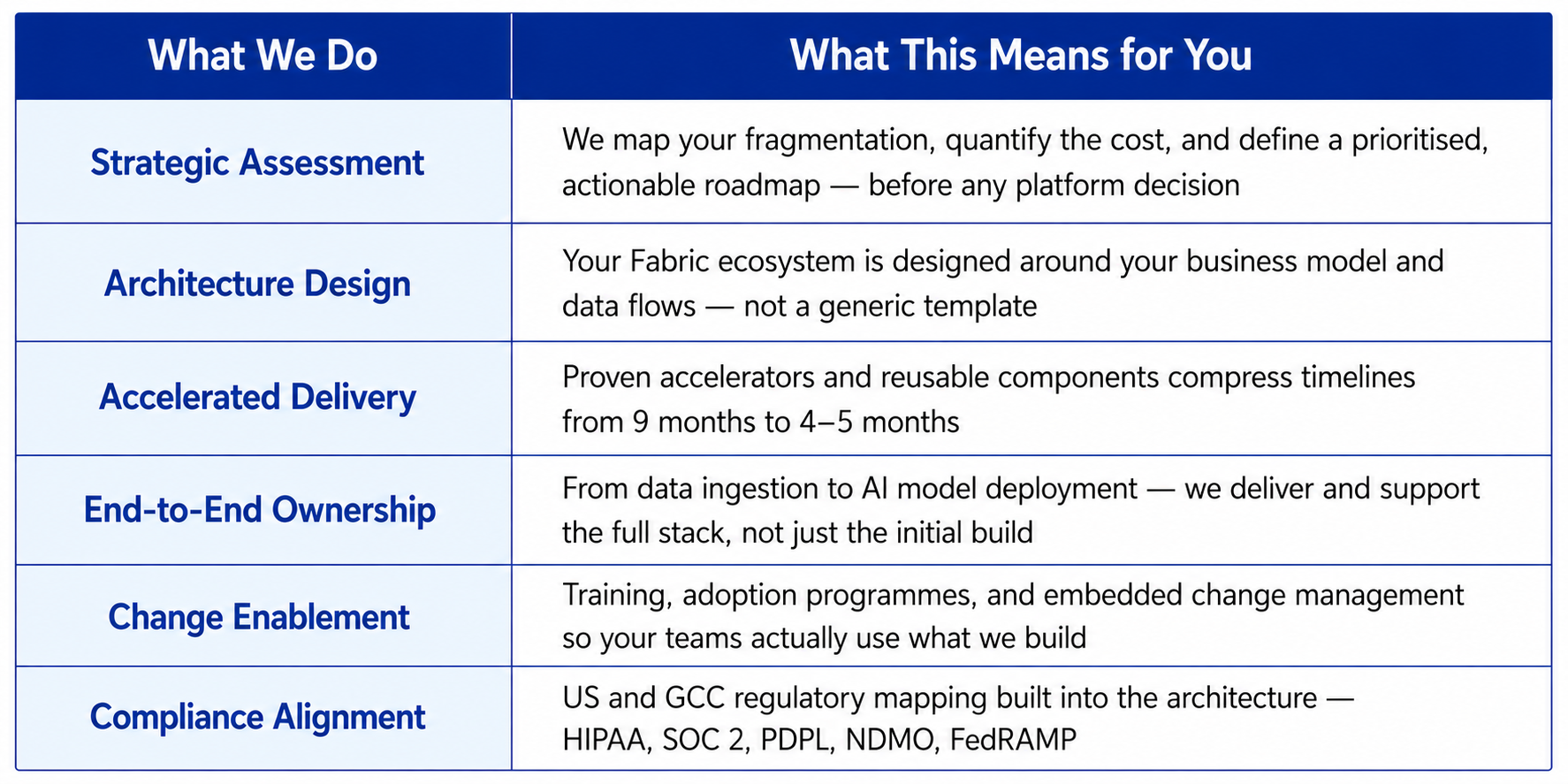
Most Fabric implementations underdeliver not because the platform fails — but because organisations treat it as a procurement decision rather than a transformation programme.
NICE, as a Trusted Microsoft Partner, architects your entire data strategy. Not just the software deployment. Here is what that difference looks like in practice:
The NICE Difference
While others are still debating which platform to buy, your organisation is already making faster decisions on better data.
That is transformation. Not just implementation.
FAQ’s
We already use Snowflake / Databricks. Do we need to migrate everything?
Not necessarily. Fabric is designed for interoperability. NICE conducts a workload assessment to identify which data domains benefit most from unification and which existing investments can be retained or federated into OneLake. Migration is phased, not a big-bang replacement.
How does Microsoft Fabric address data sovereignty requirements in Saudi Arabia and the UAE?
Fabric supports regional data residency controls, allowing organisations to specify that data is stored and processed within GCC-based Azure regions. This directly addresses NDMO data localisation requirements in Saudi Arabia and PDPL obligations in the UAE. NICE builds these controls into the architecture from day one.
How does NICE handle AI readiness as part of a Fabric deployment?
AI readiness is built into NICE’s architecture design phase — not treated as a separate workstream. This includes data quality frameworks, feature store design, MLflow integration within Fabric’s Data Science workload, and governance tagging for AI model inputs. The goal is that your first AI use case can go live within the Fabric environment, not alongside it.
What does the NICE assessment involve, and is there a cost?
NICE offers a confidential Architecture Assessment — typically a two-week engagement — that maps your current data landscape, quantifies fragmentation costs, and produces a prioritised Fabric roadmap. Assessment terms are discussed during an initial consultation. Contact us to begin.
What is the ROI timeline for a Fabric implementation?
Based on NICE deployments, organisations typically see measurable cost reduction in storage and compute within the first quarter post-go-live, with decision-cycle improvements (weeks to hours) visible within 60–90 days. Full ROI realisation, including AI workload acceleration, typically occurs within 12–18 months.
Ready to Rethink Your Data Strategy?
Book a confidential architecture assessment with a NICE data strategist.
We will map your fragmentation, quantify the cost, and design your path to AI-ready, unified data operations.
NICE Software Solutions is a Trusted Microsoft Partner specialising in Data & AI engineering across North America, the Middle East, and South Asia.
About The Authors:
Prateek Ghumare
Principal Consultant
•
Professional Services
Aditi Dagwal
Marketing Associate
Recent Blogs

The Agentic Workforce in Enterprise AI
17 Jul, 2026
The Hidden ROI in Your Snowflake Investment
28 May, 2026

Data Governance Tools
08 Jan, 2026


