
Menu
Menu
The First 100 Days: What I Learned About Scaling a Data & AI Organization
By Shailesh Wadhankar, President –Nice Software Solutions
While the first 100 days in a new organization are often associated with strategy discussions, organizational reviews, and defining clear priorities. It is also the best time to listen, observe, and understand the people and culture that drive the business forward.
Over the past few months at Nice Software Solutions, I’ve had the opportunity to engage closely with Leaders, teams, partners, and clients across the organization. What stood out immediately was the strong foundation NICE possesses—deep technical capability, committed teams, strong customer relationships, and a culture that genuinely strives to scale.
What also became clear is that scaling a modern Data & AI organization requires more than technical excellence alone. As organizations grow, the real differentiators become consistency, alignment, adaptability, and the ability to combine innovation with disciplined execution.
First 100 days = Building a Foundation, not a milestone.
Growth Requires Alignment Before Acceleration
One of the strongest realizations has been that sustainable growth cannot happen in silos. Individual teams may perform well, but real organizational scale happens when leadership aligns towards shared priorities and a common understanding of success.
This thinking led to Synergy NICE, our first leadership delivery meeting that brought together Delivery Heads, Practice Leaders, and Program Managers to strategize the future of our delivery organization. The focus was on predictable outcomes, operational excellence, customer trust, innovation, and scalable delivery practices. More importantly, it created collective ownership across leadership teams—something essential for long-term growth and organizational maturity.
Click Here to take a peek into the power-packed weekend.
Accountability Creates a Culture of Ownership
Another important learning has been that clear roles are essential in building high-performing teams.
As organizations grow, accountability becomes difficult when expectations remain undefined. To address this, we introduced leadership scorecards focused on measurable goals and stronger ownership across leadership teams.
The objective was not governance for the sake of oversight, but rather encouraging leaders to think more intentionally about customer success, operational discipline, team growth, and long-term business impact. In my experience, organizations scale faster when accountability becomes empowering rather than restrictive.
Employee Experience Is a Strategic Priority
Technology organizations naturally focus heavily on customers and delivery, but sustainable growth also depends on the experience employees have within the organization.
Over the past few months, we have redefined designation bands, introduced skip-level conversations, and built a stronger performance management framework. to create greater transparency and clarity around growth.
A strong example of this is EDGE — Employee Development & Growth Engine — our performance management platform designed to enable more meaningful growth conversations and structured employee development. EDGE is powered by GenAI, a strong reflection of our commitment to its adoption. We developed this product fully using a GenAI coding tool with one developer and completed design to implementation within 1 week, giving us 10X savings in cost, 4X savings in delivery timeline and 20X reduciton in effort. NICE itself became the “zeroth customer” for our GenAI adoption.
Reflecting on these 100 days, it is clear that shaping the employee experience requires more than just statements; it demands robust systems, consistent execution, and deliberate leadership behavior.
GenAI Will Redefine the Future of Engineering Organizations
Being in the Data & AI industry today is both exciting and transformative. Generative AI is no longer a futuristic conversation—it is actively reshaping how organizations build, deliver, innovate, and engage with customers.
At NICE, our GenAI journey is evolving across two important dimensions.
1] Internal transformation: We introduced the vision of “One Engineer, One AI Agent”—an approach focused on empowering every engineer with AI-assisted capabilities to improve productivity, accelerate execution, enhance quality, and reduce repetitive effort. The idea is not to replace human expertise, but to augment it intelligently.
We are already seeing how AI copilots and agentic workflows can help engineers move faster across development, testing, documentation, analytics, and decision-making activities. Over time, this shift has the potential to fundamentally redefine how modern engineering organizations operate.
2] Customer Transformation: We are building structured frameworks that help our teams engage customers in more strategic conversations around GenAI opportunities, business impact, implementation readiness, and value realization.
This is an important mindset shift. GenAI success is not just about deploying models—it is about identifying where AI can meaningfully improve decision-making, productivity, customer experience, and operational efficiency.
What excites me most is that we are not approaching GenAI as a standalone technology trend. We are integrating it into the way we think, deliver, collaborate, and create value—both internally and for our customers.
Organizations that successfully combine human expertise, domain knowledge, and AI augmentation will define the next generation of technology services.
Discover how NICE AI transforms productivity and unlocks business value with GenAI.
Process-Driven Excellence Is Essential for Scale
Perhaps the most important insight from these first 100 days has been the need to transition from person-dependent execution to process-oriented delivery excellence.
As companies grow, consistency cannot rely solely on individual capability. It must be institutionalized through governance frameworks, repeatable best practices, and customer-centric operating models.
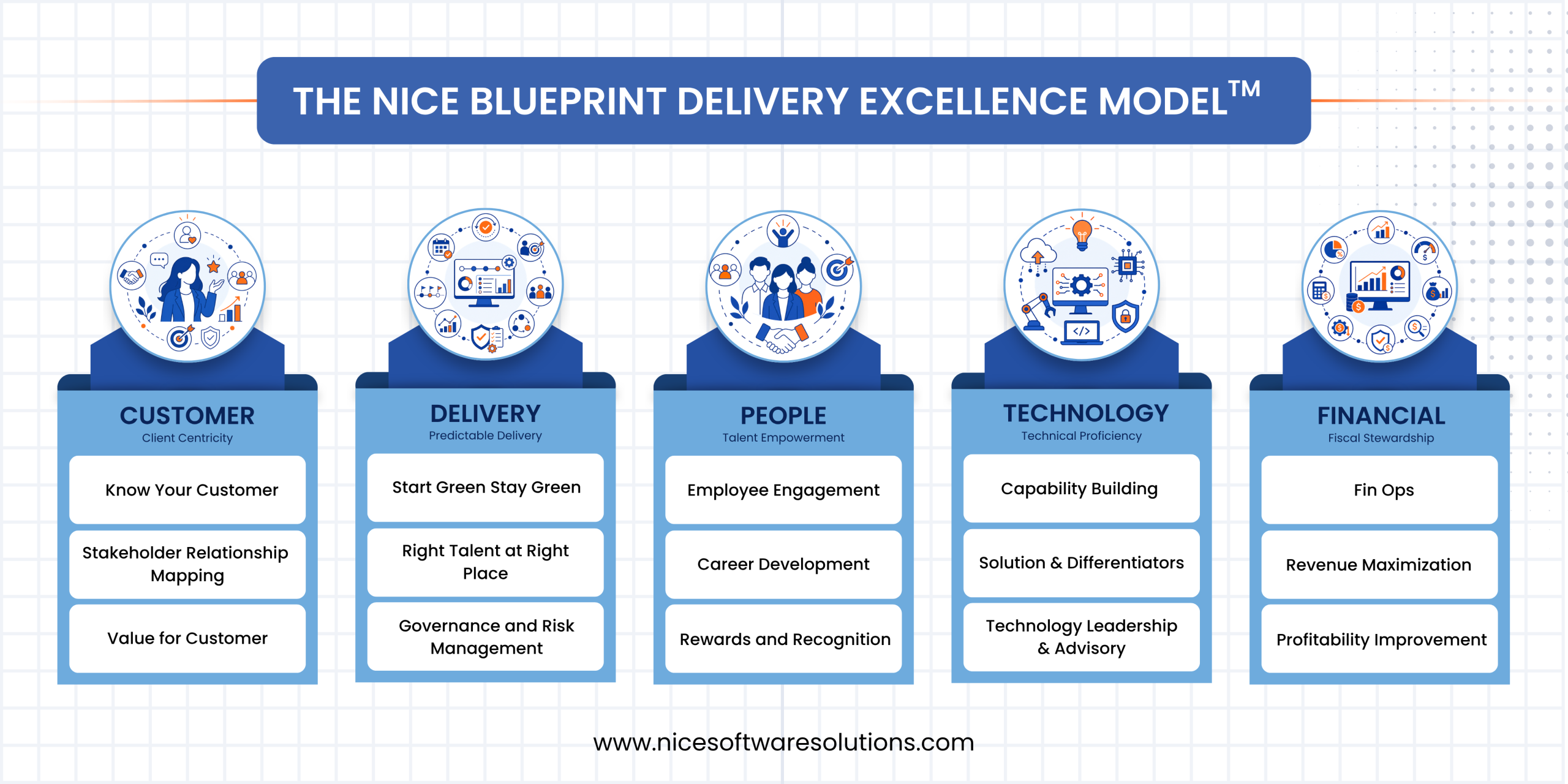
This philosophy led to the establishment of The NICE Blueprint—our delivery governance framework built around five pillars: Customer, Delivery, People, Technology, and Financial Stewardship. The framework reflects a broader shift toward building a scalable, business-oriented organization capable of delivering long-term customer value consistently.
Looking Ahead
What gives me the most confidence about NICE is the openness I have seen across the organization—the willingness to adapt, improvise, collaborate, and think bigger.
The past 100 days were not about quick transformation. They were about building the right foundation. The real impact will come through disciplined execution, leadership consistency, and our collective ability to evolve with the changing technology landscape.
There is tremendous potential within NICE, and I believe we are only beginning to unlock it.

Shailesh Wadhankar
President
Recent Blogs


Data Governance Tools
08 Jan, 2026


Looking Forward to Elevating Your Workforce
08 Jan, 2026

Navigating the Evolution of DATA SCIENCE
07 Jan, 2026